
If you are repairing a drain, renovating a basement, or opening walls in an older Toronto-area home, you may find black ABS pipe, white PVC pipe, or both. The better material is not simply the one that looks stronger. It is the material approved for the specific application, compatible with the existing system, and installed with the correct fittings and solvent cement. For most homeowners, the decision comes down to four questions: Is the pipe carrying drainage or pressurized water? What material is already in the house? Will the pipe be exposed to impact, sunlight, or cold? What does the approved design and local inspection process require?
The Short Answer
ABS and PVC are both durable plastic piping materials, but they are not interchangeable in every situation.
- ABS is commonly recognized by its black colour and is widely used for drain, waste, and vent systems. It is lightweight, impact-resistant, and joined with an ABS-compatible solvent cement.
- PVC is usually white or grey and is available in different formulations and schedules for different uses. The correct product, fittings, primer where required, and cement must match the application.
- Neither standard ABS DWV nor standard PVC DWV should be treated as a universal hot- and cold-water supply pipe. Pressurized potable-water systems use products specifically listed and approved for that service.
- The safest choice is usually to continue with the approved material already serving the same function, unless the renovation design calls for a properly approved transition.
What Is ABS Plumbing Pipe?
ABS stands for acrylonitrile butadiene styrene. In homes, it is most familiar as black drain, waste, and vent—or DWV—pipe. A DWV system carries wastewater away and allows air into the drainage system so traps work properly and sewer gases stay out of living spaces. ABS is useful where installers need a light, workable pipe that tolerates normal job-site handling. Its dark colour also makes it easy to identify when a wall or ceiling is opened.
Advantages of ABS
- Good impact resistance during handling and service
- Lightweight sections that are straightforward to cut and position
- A one-step solvent-weld process when the specified ABS cement permits it
- Common use in residential DWV work, making compatible fittings readily recognizable
Limitations of ABS
- Prolonged ultraviolet exposure can degrade unprotected pipe
- A poorly cut, dry-fitted, or inadequately cemented joint can leak
- It is not automatically approved for every drainage, pressure, or exterior application
- Pipe movement and support still matter; “flexible” does not mean it can be bent around obstacles
What Is PVC Plumbing Pipe?
PVC stands for polyvinyl chloride. It is a rigid plastic used in many piping products, but the word “PVC” alone does not identify the pipe’s approved use. Colour, schedule, certification markings, and manufacturer instructions all matter. Homeowners often encounter PVC in drainage, underground, irrigation, or other specialized systems. A white plastic water line may also be a different product, such as CPVC, rather than ordinary PVC. The printed markings on the pipe are more reliable than colour alone.
Advantages of PVC
- Good resistance to many corrosive conditions
- Rigid pipe runs that hold alignment when properly supported
- Many fittings and product classes for defined applications
- Smooth interior surfaces that support efficient flow when the system is correctly sized and graded
Limitations of PVC
- Some PVC products can become more vulnerable to impact in cold conditions
- Joint preparation may require primer as well as the correct cement
- The many product types make assumption-by-colour risky
- A PVC product approved for one use may not be approved for another
ABS vs. PVC at a Glance
| Decision factor | ABS | PVC |
|---|---|---|
| Typical residential identification | Black pipe | Often white or grey pipe |
| Common homeowner encounter | Drain, waste, and vent systems | Drainage and other product-specific systems |
| Handling | Light and impact-resistant | Rigid; impact performance depends on product and temperature |
| Joining | Compatible ABS solvent cement | Product-specific primer and cement where required |
| Sunlight | Requires protection from prolonged UV exposure | Exposure limits depend on the product and manufacturer |
| Best reason to choose it | It is approved for the use and compatible with the existing DWV system | The specific PVC product is approved for the use and suits the design |
| Main homeowner warning | Do not use it as a universal supply pipe | Do not assume every white pipe is suitable for potable or hot water |
Where Each Material Works Best
Drain, Waste, and Vent Work
Both materials can appear in drainage work, but approval and compatibility govern the choice. For a small repair, continuing the existing approved material can reduce unnecessary transitions. For a larger renovation, the plumbing design may standardize new runs in one material while using listed transition fittings where needed. Drain performance depends on more than pipe material. Diameter, slope, venting, trap configuration, cleanout access, support spacing, and connection sequence all affect whether the system drains quietly and reliably.
Potable-Water Supply
Do not select ABS or PVC DWV pipe for pressurized drinking-water service just because the diameter looks right. Water-supply materials must be specifically rated, certified, and installed for potable pressure service. A plumber may recommend copper, PEX, CPVC, or another approved system based on the project and local requirements.
Exposed, Exterior, or Cold Locations
Plastic pipe should be protected from physical damage and installed within its temperature and exposure limits. Toronto and GTA renovations also need freeze protection where piping approaches exterior walls, garages, crawlspaces, or other unconditioned areas. Insulation alone cannot correct a pipe placed outside the building’s effective thermal envelope.
Can ABS and PVC Be Connected?
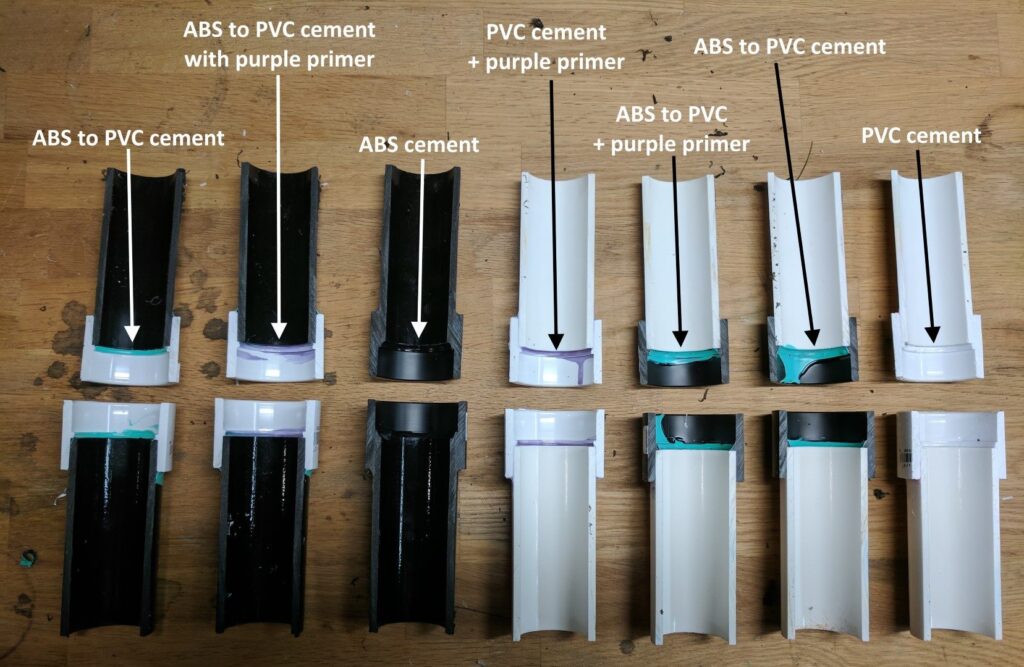
They can be transitioned only with a method approved for the materials, location, and application. The solution may be a listed mechanical transition coupling or another approved fitting. Smearing a general-purpose adhesive over mismatched pipe is not a reliable connection. Before joining systems, confirm:
- the exact material and markings on both pipes;
- whether the connection is above grade, below grade, concealed, or exposed;
- whether the line is drainage, venting, or pressurized;
- the transition fitting’s listing and manufacturer instructions; and
- whether the work requires a permit or inspection.
Installation Details That Matter More Than Colour
Even the correct pipe can fail when the installation is careless. A dependable installation starts with square cuts, deburred ends, clean mating surfaces, full insertion into the fitting hub, and the correct solvent system. The installer must allow the joint to cure as directed before testing or loading it. DWV pipe also needs continuous, properly spaced support and intentional slope. Excessive slope is not a substitute for correct design, and a sag can hold wastewater. Vents must remain connected and unobstructed. Concealed work should be tested and inspected before drywall closes the assembly.
Common Homeowner Mistakes
- Choosing by colour without reading the pipe markings
- Assuming drainage pipe is suitable for pressurized water
- Mixing cements, primers, or fittings from incompatible systems
- Using a rubber connector that is not listed for the location
- Closing a wall before testing and required inspection
- Ignoring a vent because “the drain still works”
- Placing water lines in vulnerable exterior-wall cavities without a complete freeze-protection strategy
A Practical Homeowner Decision Checklist
Before buying pipe or approving a plumbing quote, ask:
- What service will this pipe carry?
- What material and certification markings are on the existing pipe?
- Is the proposed product approved for that service and location?
- Are all fittings, primer, cement, and transition components compatible?
- Will the work alter drainage, venting, or water distribution enough to require a permit?
- Who will arrange testing and inspections before the work is concealed?
- How will the pipe be supported, protected, and kept within the conditioned envelope?
These questions are more useful than asking whether ABS or PVC is “better” in the abstract.
When to Call a Professional
A straightforward exposed repair may look simple, but concealed plumbing can affect multiple fixtures and finished rooms. Bring in a qualified contractor and the appropriate plumbing trade when the work changes pipe size, relocates fixtures, creates a new bathroom or kitchen, crosses between materials, penetrates fire separations, or involves a recurring sewer-gas or drainage problem. GMC Construction coordinates renovation plumbing with framing, waterproofing, cabinetry, and inspection milestones so the finished room is built around a serviceable system—not around a hidden compromise.
Conclusion
ABS and PVC can both perform well when the exact product is approved, compatible, and correctly installed. ABS remains a familiar choice for residential DWV work; PVC covers a broad range of product-specific applications. The right decision for your home depends on the pipe’s service, existing system, exposure, and approved renovation design. Read the markings, avoid improvised transitions, and have concealed work tested before finishes go back on.