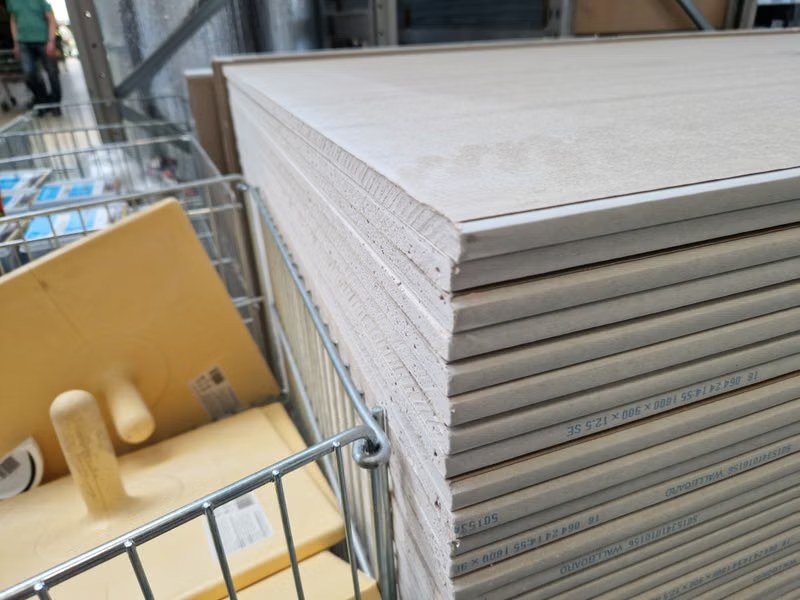
Drywall is not one universal product. Standard gypsum board, lightweight panels, moisture- and mould-resistant products, Type X assemblies, acoustic panels, and tile backer boards serve different conditions.
Choosing the right product affects fire safety, sound control, moisture performance, installation, and finish durability. This guide focuses on board selection and material benchmarks. Hanging, taping, mudding, priming, and painting are separate parts of the installed cost.
Drywall Material Cost Comparison
The following material-only figures are 2026 Toronto and GTA ranges shown before 13% HST. They cover the board itself and do not include hanging, taping, mudding, sanding, priming, or painting.
| Board or cost category | 2026 planning range (before HST) | Typical selection context |
|---|---|---|
| Regular drywall | $0.55–$0.85 per sq. ft. | General dry interior walls and suitable ceilings |
| Lightweight drywall | $0.60–$0.95 per sq. ft. | Walls or ceilings where the approved panel suits the span |
| Moisture-resistant drywall | $0.70–$1.10 per sq. ft. | Humid rooms outside direct-wet tile zones |
| Type X fire-resistant drywall | $0.70–$1.15 per sq. ft. | Listed fire-resistance assemblies |
| Mould-resistant drywall | $0.95–$1.50 per sq. ft. | Damp-prone rooms after moisture sources are controlled |
| Cement board | $1.20–$2.20 per sq. ft. | Tile substrate in wet or demanding areas; not gypsum drywall |
| Sound-control drywall | $1.80–$3.50 per sq. ft. | Selected acoustic wall and ceiling assemblies |
| Example installed Level 4 residential finish | $3.00–$4.50 per sq. ft. | 2026 GTA benchmark for supply, hang, tape, and finish |
| Waste allowance | 10%–15% | Confirm against sheet layout and project conditions |
Material price varies with thickness, panel dimensions, supplier, quantity, delivery, and product certification. Compare identical specifications rather than colour or product nickname.
Regular Drywall
Standard paper-faced gypsum board is used for many dry interior walls and suitable ceilings. It accepts conventional joint treatment and paint and is available in several lengths and thicknesses.
Use it where no special fire, moisture, impact, or acoustic performance is required. Ceiling spans, framing spacing, and texture weight must match the panel’s rating to reduce sagging risk.
Lightweight Drywall
Lightweight panels reduce handling effort and can simplify overhead installation. They are not automatically appropriate for every ceiling or listed fire assembly.
Confirm thickness, span rating, edge type, and product listing. Do not substitute a lightweight product into a specified assembly simply because the sheet dimensions match.
Moisture-Resistant Drywall
Moisture-resistant drywall, often called green board, is made to perform better than standard board in humid conditions. It may suit selected bathroom, laundry, or kitchen areas outside direct water exposure.
It is not waterproof. A shower or continuously wet tile zone needs an approved backer and a complete waterproofing system. Bathroom paint does not turn gypsum board into a wet-area substrate.
Moisture- and Mould-Resistant Drywall
Some products combine increased moisture resistance with materials designed to resist mould growth. Performance varies, so read the product data rather than relying on facing colour.
These panels can be useful in basements, bathrooms, and laundry rooms after leaks, condensation, and humidity sources are controlled. No board can compensate for active foundation water entry.
Type X and Fire-Resistant Drywall
Type X gypsum board is commonly used within tested fire-resistance assemblies. The board alone does not create a universal rating.
Fire performance depends on the complete assembly, including:
- Stud material and spacing
- Number and orientation of layers
- Fasteners and joint treatment
- Insulation
- Penetrations and openings
- Continuity at floors, ceilings, and adjoining walls
Garages, mechanical rooms, exits, and separations between dwelling areas may require particular assemblies. Follow the approved design rather than improvising with one labelled layer.
Sound-Control Drywall
Specialty acoustic panels add mass and damping within a designed wall or ceiling assembly. They can help around bedrooms, home offices, theatres, mechanical rooms, and shared walls.
Sound can bypass an expensive panel through gaps, outlets, ducts, doors, floors, ceilings, and rigid framing connections. Mineral fibre, resilient connections, sealant, additional mass, better doors, and service detailing may matter as much as board type.
Cement Board and Tile Backers
Cement board is often compared with moisture-resistant drywall, but it is not gypsum board. It is used as a tile substrate in showers and other wet or demanding areas when incorporated into an approved waterproofing assembly.
Cement board alone is not the waterproofing system. Joints, fasteners, corners, niches, penetrations, curbs, drains, and membrane transitions all need coordinated detailing.
Foam backer boards and coated gypsum tile backers may also be suitable when the complete system is approved for the location.
Other Specialty Panels
Specialty boards include impact-resistant, abuse-resistant, flexible, exterior-sheathing, shaftliner, lead-lined, and products marketed for selected indoor-air functions.
Review the manufacturer’s tested claims, compatible finishes, installation requirements, expected service life, and disposal information. Specialty panels should not be substituted for standard board without confirming the complete application.
How to Choose Drywall by Room
Living Rooms, Bedrooms, and Hallways
Start with regular or approved lightweight board. Upgrade selected walls for sound or impact control based on how the room is used.
Kitchens
Standard board often works in dry areas. Use a suitable moisture-resistant product where humidity or splashing justifies it, and use an approved substrate and waterproofing behind high-exposure finishes.
Bathrooms and Laundry Rooms
Separate humid zones from direct-wet zones. Moisture- or mould-resistant gypsum may suit walls and ceilings outside the shower. The tub or shower surround needs a complete wet-area design.
Basements
Repair water entry, capillary moisture, and condensation before selecting board. Choose the panel as part of the insulation, vapour, framing, and drainage strategy. Do not install drywall against an actively wet foundation.
Garages and Mechanical Areas
Follow the required fire-separation assembly and protect the board from impact and water. Openings and service penetrations are part of the assembly.
Home Offices and Theatres
Define the noise source and performance goal before choosing a sound-control panel. A coordinated wall, ceiling, door, duct, and sealant strategy outperforms a single “soundproof” board installed in a leaky room.
Thickness and Panel Size Matter
Thickness affects stiffness, weight, acoustic mass, fire listings, and alignment with trim and openings. Panel length affects the number of joints and whether sheets can reach the room.
Before ordering, confirm:
- Wall or ceiling application
- Framing spacing and direction
- Required fire, acoustic, or wet-area assembly
- Moisture exposure
- Door, window, and trim build-up
- Access route and lifting method
- Sheet orientation and joint layout
- Waste for cuts and damaged edges
Material Price Is Not Installed Price
A complete drywall scope can also include delivery, carrying, protection, fasteners, adhesive where specified, beads, backing, access panels, insulation, acoustic sealant, tape, compound, sanding control, primer, disposal, and labour.
Ceilings, tall walls, stairwells, curved surfaces, many openings, occupied-home protection, and high finish levels change the installation cost. Ask the quotation to separate board material, hanging, finishing, and painting.
Common Selection Mistakes
- Using moisture-resistant gypsum in a shower without waterproofing
- Assuming Type X board alone creates a rated separation
- Buying acoustic board while leaving major sound paths untreated
- Hanging drywall before basement moisture is resolved
- Substituting a thinner or lighter board into a listed assembly
- Ignoring ceiling span ratings
- Ordering sheets that cannot reach the room intact
- Comparing prices without matching thickness, dimensions, and specification
Questions to Ask Before Ordering
- What performance does the room require?
- Is there an approved fire, acoustic, or wet-area assembly?
- What thickness and dimensions match the framing?
- Are all layers, fasteners, sealants, and membranes compatible?
- How will penetrations and openings be detailed?
- Has moisture been measured and its source corrected?
- Does the quote separate material, installation, and finishing?
- How will sheets enter the building and remain dry?
Coordinate Drywall with GMC Construction
The best drywall is the product that fits the complete assembly and the room’s actual exposure. Standard board suits many dry interiors; moisture-resistant products help in humid areas; Type X belongs in a designed fire assembly; and acoustic products need complete sound-control detailing.
GMC Construction has completed more than 500 projects and has a 5.0-star rating based on 85+ Google reviews. The company is insured and WSIB covered.
Planning drywall work as part of a renovation in Toronto, Richmond Hill, North York, Thornhill, Markham, or Vaughan? Call GMC Construction at 647-450-4466.
Ready to turn this into a real project?
Take what you just read and connect it to our home renovation service — we’ll scope project type, location, timing and budget so you get an accurate quote.
Get a free estimate for your project
Tell us what you're planning and our team will get back to you within 24–48 hours. No obligation.