
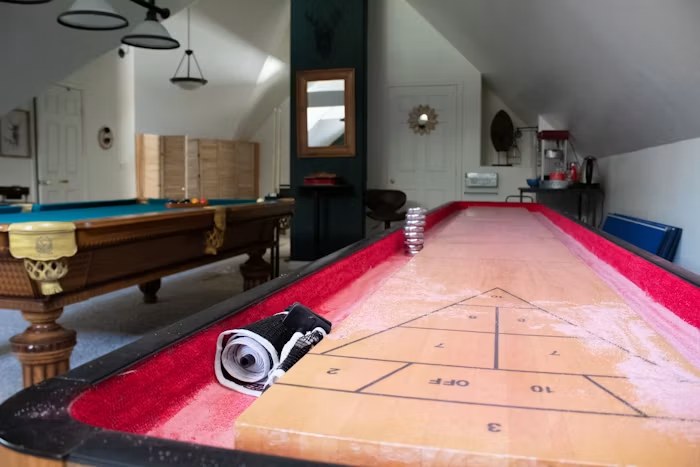
A basement game room can bring noisy, social, and screen-based activities into one dedicated space. The best design depends on what you play, who uses the room, and whether the basement must also support movies, exercise, homework, or guests.
Start with the equipment and clearances, then plan seating, storage, lighting, power, and sound control around them. This approach produces a game room that is comfortable to use—not just a collection of games placed in an empty basement.
Choose the Main Type of Game Room
Classic arcade room
An arcade-inspired basement works well for pinball machines, upright cabinets, and retro décor. Place machines along the walls to preserve a clear central path. Confirm outlet locations, ventilation needs, and equipment dimensions before building millwork around a collection.
Use bold graphics selectively. A dark wall, neon-style accent, or framed game art can establish the theme without making the entire basement visually busy.
Console and media gaming room
For console gaming, prioritize screen visibility, comfortable viewing distance, low-glare lighting, and accessible charging. A low media cabinet can store controllers and devices while allowing airflow.
If the same room is used for movies, choose seating that works for both active gaming and longer viewing sessions. Dimmable ambient light and a separate task light near storage make the room easier to reset.
Pool and table-games room
A pool, ping-pong, air-hockey, or foosball table needs more than its physical footprint. Players require clear space around every active side. Mark the table and play zone on the floor before buying equipment.
Pendant lighting can define the table, but fixture height and position should not obstruct play. Add a wall rack or closed cabinet for cues, paddles, balls, and accessories.
Board-game and card room
A large table, supportive chairs, and glare-free overhead lighting form the centre of a board-game room. Use shallow drawers or labelled cabinets so games are easy to find without stacking heavy boxes too high.
Include side surfaces for snacks and personal items, and select durable finishes that can handle frequent use. If the table also serves crafts or homework, protect the surface and provide nearby supply storage.
Virtual-reality room
Virtual-reality gaming needs an unobstructed play zone. Keep low furniture, ceiling fans, projecting shelves, and loose cables away from the active area. A resilient floor and a clearly defined boundary can help users remain oriented.
Place the computer or console where it can ventilate properly and where cables do not cross the walking path. Confirm equipment guidance for play-area dimensions before finalizing the room.
Sports lounge
A sports-focused game room combines a viewing area with one or two interactive features, such as a compact basketball game, dartboard, or table game. Durable wall protection and organized equipment storage keep active games from damaging nearby finishes.
Use team colours and memorabilia as accents. A few well-placed items usually feel more polished than covering every surface.
Plan the Room Around Movement
Draw the basement to scale and mark stairs, doors, posts, bulkheads, windows, and mechanical access. Then add the game equipment at its actual dimensions plus the required play space.
Keep a direct route between the stairs, seating, washroom, and exits. Do not let chairs, cue zones, or open cabinet doors block the main circulation path. In a low-ceilinged area, avoid placing active games beneath ducts or beams where players may raise their arms.
Build a Flexible Multi-Game Layout
Few basements are large enough for every activity to remain set up permanently. Folding tables, wall-mounted game storage, nesting side tables, and modular seating allow the room to change without feeling temporary.
Divide the basement into an active zone and a seated zone. The active side can hold table games or VR, while the seated side supports consoles, movies, or conversation. Use rugs, lighting, or furniture orientation to define the zones without building walls.
Design the Screen and Audio Area Carefully
Place the screen based on the primary seating position and test the height before mounting. Account for reflected light from windows and ceiling fixtures. If the room includes a projector, plan the throw distance, screen location, wiring path, and control of ambient light together.
Sound systems need wiring, ventilation, and neighbour-friendly volume control. In attached or semi-detached Toronto-area homes, bass and impact noise can travel through framing. Acoustic insulation, resilient assemblies, door seals, rugs, and soft finishes can reduce transmission and echo when planned as part of the renovation.
Use Lighting for Different Types of Play
A game room should not rely on one lighting mode. Combine:
- Bright, even light for cleaning and setup
- Focused light over pool, cards, or board games
- Low-glare ambient light for screens
- Accent lighting for shelves or themed displays
- Separate controls or dimmers for each zone
Keep decorative lighting out of direct sightlines and avoid placing bright strips where they reflect in the television. Accessible controls make it easy to change the atmosphere without moving furniture.
Plan Enough Power and Data
List every console, screen, computer, charger, table game, mini appliance, and lighting component. Locate outlets where equipment will sit and provide a cable-management route inside cabinets or behind the media wall.
Reliable data is important for online gaming and streaming. If wireless coverage is inconsistent in the basement, consider a hardwired connection or a planned network solution. Electrical and data planning should happen before drywall and built-ins are complete.
Choose Durable, Basement-Suitable Finishes
Game rooms experience rolling chairs, moving tables, food, and frequent traffic. Choose flooring that suits the basement conditions and the activities. Soft surfaces can improve comfort and acoustics, while resilient surfaces are easier to clean.
Use washable paint, protected corners, and durable cabinet finishes. Before any finish work, resolve moisture or water-entry concerns. Do not conceal a damp wall behind decorative panels or storage.
Add Storage for Games and Accessories
Storage keeps the room usable between game nights. Provide:
- Closed cabinets for controllers, cables, and small accessories
- Adjustable shelves for changing collections
- Wall storage for cues, paddles, or sports equipment
- Charging drawers or shelves near outlets
- A designated place for board games and card supplies
- Bins for children’s games that are easy to return
Leave ventilation around electronics and avoid placing heavy equipment on shelves not designed for the load.
Make the Game Room Comfortable for Everyone
Include a mix of seating rather than one long row. Supportive chairs work for table games, a sofa suits movies, and movable stools help when more people join. Keep at least one clear route through the room even when all seats are occupied.
If the basement also serves children, choose secure storage, rounded edges where practical, and a layout adults can supervise. If it serves adults and teenagers, provide enough separation between active and quiet games so both can happen at once.
Plan the Renovation Budget Separately
The renovation scope may include insulation, electrical work, drywall, flooring, lighting, cabinetry, and sound control, while game equipment and furniture are separate purchases. Keeping those categories separate makes it easier to prioritize the room itself before adding specialty equipment.
For current local renovation budgeting, review the basement renovation cost guide. This game-room guide stays focused on layout and design rather than duplicating cost information.
Create a Game Room That Can Evolve
A useful basement game room has enough clearance for play, enough storage to reset the space, and the lighting, power, and sound control to support different activities. Plan those fundamentals first, then add the theme and equipment that reflect your household.
GMC Construction builds basement recreation spaces throughout Toronto and the GTA. To discuss a game-room renovation, call 647-450-4466.
Ready to turn this into a real project?
Take what you just read and connect it to our basement renovation service — we’ll scope project type, location, timing and budget so you get an accurate quote.
Get a free estimate for your project
Tell us what you're planning and our team will get back to you within 24–48 hours. No obligation.