
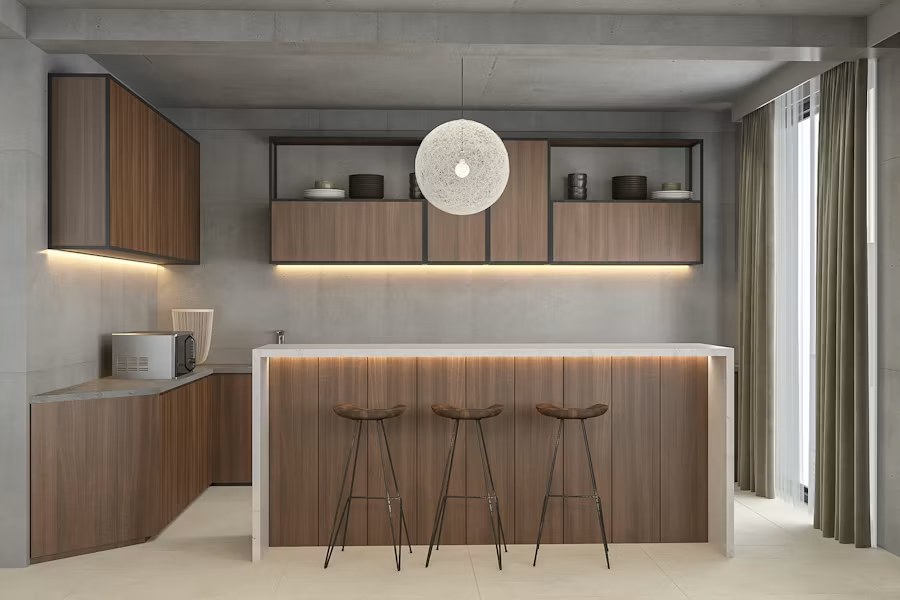
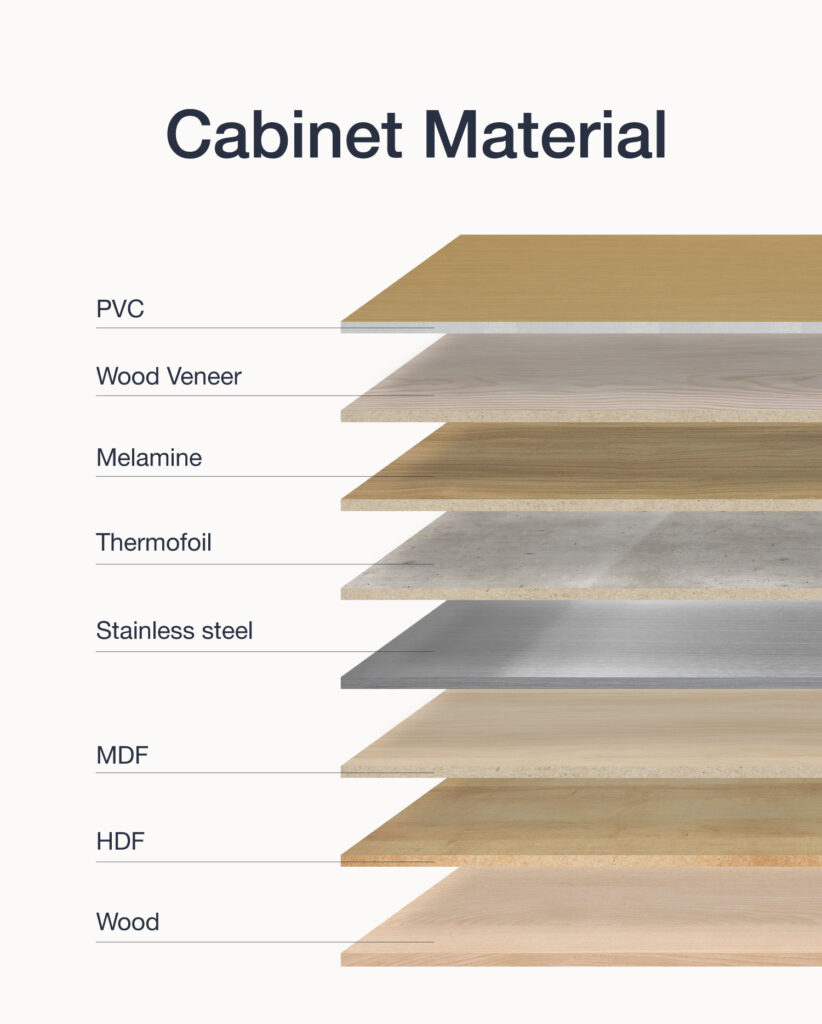
“Wood cabinets” can describe a solid-wood door on an MDF centre panel, a plywood cabinet box, a particleboard shelf, or a mix of all three. The best cabinet specification rarely uses one material everywhere. It assigns each material to the job it performs best. To compare cabinets properly, separate the box, doors, drawer parts, exposed panels, interior finish, edge treatment, joinery, and hardware. A durable plywood box with poorly protected edges can fail near a leak, while a well-built particleboard cabinet with strong hardware and sealed surfaces can perform reliably in a dry kitchen.
Understand the Parts of a Cabinet
Cabinet Box
The box forms the sides, top, bottom, and back. Plywood and particleboard or furniture board are common. Box thickness, back construction, wall anchoring, and shelf support matter as much as the material name.
Doors and Drawer Fronts
Solid wood, MDF, thermofoil-wrapped MDF, melamine-faced panels, veneer, and other decorative surfaces can all be used. The best choice depends on door style, finish, heat exposure, and repair expectations.
Drawers
Drawer-box material, bottom thickness, joinery, and slide rating determine how the drawer behaves under pots, dishes, or pantry loads. A premium door does not compensate for weak drawers.
Exposed Panels and Fillers
End panels, toe kicks, fillers, crown, light valances, and appliance panels should be specified with the same care as the doors. Colour and sheen can vary between materials even when the finish name is identical.
Hardware
Hinges, slides, lift mechanisms, and fasteners affect daily performance. Look for appropriate load ratings, adjustment, soft-close function, warranty, and replacement availability.
Compare Cabinet Materials and Relative Cost
This table compares cost position rather than generic dollar figures. Final pricing depends on cabinet construction, thickness, grade, finish, door style, hardware, customization, and installation.
| Material | Common cabinet use | Durability and moisture behaviour | Finish options | Relative material cost |
|---|---|---|---|---|
| Solid wood | Door frames, drawer fronts, face frames, trim | Durable and repairable; expands and contracts with humidity | Stain, clear finish, paint | Higher |
| Plywood | Cabinet boxes, shelves, drawer boxes, structural panels | Strong for its weight; edge and veneer quality still matter around leaks | Veneer, laminate, paint-grade skins | Moderate to higher |
| MDF | Painted doors, centre panels, decorative profiles, some boxes | Smooth and stable; vulnerable if water reaches an unfinished edge or damaged surface | Excellent for paint, thermofoil, veneer | Moderate |
| Particleboard or furniture board | Boxes, shelves, panels, budget and mid-range cabinetry | Consistent and flat; fastener holding and water resistance depend on density and construction | Melamine, laminate, veneer | Lower to moderate |
| Thermofoil | Wrapped MDF doors and panels | Easy to clean; heat or failed edges can cause lifting or discolouration | Smooth, shaker, and moulded profiles | Lower to moderate |
| Melamine | Cabinet interiors, boxes, shelves, slab doors | Hard, cleanable surface; chipped edges and exposed core are vulnerable | Solid colours, wood looks, textures | Lower to moderate |
Solid Wood
Solid wood is most often used for door frames, drawer fronts, face frames, and trim rather than every surface of the cabinet box. Species such as maple, oak, cherry, and walnut differ in grain, hardness, colour change, and stain response.
Strengths
- natural grain and variation;
- repairable scratches and dents in many finishes;
- strong frame construction;
- long service life when properly finished; and
- good fit for stained, traditional, and furniture-style cabinetry.
Limitations
Wood moves with seasonal humidity. Wide solid panels can expand, contract, cup, or show joint lines. Painted solid-wood doors may reveal movement at the rails and stiles over time. Water can still stain or distort wood if a leak is not addressed. Choose solid wood because the natural material and repairability are valuable—not because “solid” automatically means every component is stronger than a well-engineered alternative.
Plywood
Plywood uses cross-laminated veneers to create a strong, dimensionally stable panel. It is widely used for cabinet boxes, shelves, and drawer boxes.
Strengths
- strong screw and fastener holding in suitable grades;
- good stiffness-to-weight ratio;
- edges show layered veneers rather than loose particles;
- suitable for robust box and drawer construction; and
- available with finished or paint-grade faces.
Limitations
Not all plywood is equal. Veneer thickness, number of plies, core voids, face quality, adhesive, flatness, and edge finishing vary. A thin decorative veneer can chip, and exposed edges still absorb water. Ask for the actual box and shelf specification. “Plywood construction” may exclude backs, drawer bottoms, toe kicks, and other parts.
MDF
Medium-density fibreboard is made from refined wood fibres and resin pressed into a smooth panel. Its uniform surface is excellent for painted doors and detailed profiles.
Strengths
- smooth paint finish without visible grain;
- stable flat surface;
- consistent machining for shaker and routed profiles;
- reduced risk of rail-and-stile paint lines on one-piece doors; and
- efficient use in contemporary painted kitchens.
Limitations
MDF is heavy and can lose strength when water enters an unfinished or damaged edge. Deep profiles can leave thin areas vulnerable to damage. Fasteners and hinges require appropriate pilot holes, screw selection, and material density. MDF can be an excellent painted-door material when edges, backs, hinge points, and wet zones are properly detailed.
Particleboard and Furniture Board
Particleboard is made from wood particles bonded into a flat panel. High-quality furniture board can provide consistent thickness, smooth finished surfaces, and efficient cabinet production.
Strengths
- flat and predictable;
- efficient for melamine-faced interiors;
- available in many thicknesses and finishes;
- often lower in cost than plywood; and
- can perform well in standard dry kitchen use.
Limitations
Performance varies with density, thickness, fasteners, shelf span, edge sealing, and hardware. Water can swell an exposed core, and damaged screw holes may be difficult to repair. Long shelves need adequate thickness or support to avoid sagging. Do not compare a high-density furniture board with a thin low-density panel by name alone. Review construction details and warranty.
Thermofoil
Thermofoil is a vinyl film formed over an MDF door or panel using heat and pressure. It creates a seamless face and wrapped edges on many profiles.
Strengths
- smooth, consistent finish;
- easy routine cleaning;
- no paint brush marks or wood-grain variation;
- available in simple and moulded door styles; and
- usually positioned below custom painted wood in price.
Limitations
Heat from ovens, toasters, kettles, and other appliances can damage or loosen the film if clearances and heat shields are inadequate. Once the wrap peels or discolours, invisible repair is difficult. Back edges and drilled openings still need protection from moisture. Confirm appliance clearances and the cabinet manufacturer’s heat-shield requirements.
Melamine
Melamine is a resin-impregnated decorative surface fused to particleboard or MDF. It is common inside cabinet boxes and on shelves, and it can also be used for slab doors.
Strengths
- hard, easy-to-clean surface;
- consistent colour and texture;
- broad choice of wood looks and solids;
- practical cabinet interiors; and
- efficient cost.
Limitations
Edges require banding, and chipped corners can expose the core. Colour matching between batches or replacement parts may vary. Thin shelves can sag under heavy loads if unsupported. Inspect edge-banding thickness, seam quality, shelf spans, and hinge boring rather than judging only the face.
Laminate and Veneer as Surface Choices
Laminate and wood veneer are finishes applied to a core, not standalone box structures. High-pressure laminate can provide a durable decorative face, while wood veneer offers real-wood grain with more panel stability than a wide solid board. The core, adhesive, edge treatment, and repair method determine how the finished panel performs. Ask the supplier to name both the surface and the substrate. “Walnut cabinet” may mean solid walnut, walnut veneer on plywood, or a printed melamine wood look.
Choose Materials by Location
Sink Cabinet
The sink base is the most leak-prone cabinet. Prioritize a durable finished interior, sealed penetrations, a removable protective tray or leak sensor, and accessible shutoffs. No wood-based panel is immune to a long, unnoticed leak.
Dishwasher and Range
Protect cabinet edges beside the dishwasher from steam and leaks. Around the range or wall oven, follow appliance clearances, ventilation, and heat-shield requirements—especially with thermofoil.
Pantry and Wide Shelves
Shelf thickness, span, edge profile, and support matter more than the door material. Heavy appliances and canned goods can cause sagging in an underspecified shelf.
Painted Feature Cabinets
MDF offers a smooth painted surface, while solid wood provides natural detail and repairability. A combination—wood frame with MDF centre panel—is common because it balances movement and finish quality.
High-Traffic Family Kitchen
Prioritize washable finishes, strong drawer boxes, quality slides and hinges, replaceable parts, and impact-resistant edges. A practical material in a strong construction often outperforms a premium face on a weak box.
Look Beyond the Material Name
Before approving cabinetry, ask for:
- box, back, shelf, and drawer-bottom thicknesses;
- core material for every major component;
- plywood grade or furniture-board density where available;
- door construction and finish system;
- edge-banding material and thickness;
- shelf spans and load support;
- drawer-box joinery and slide rating;
- hinge make, adjustment, and opening angle;
- wall-anchoring method;
- finished end panels, fillers, toe kicks, and trim;
- appliance heat shields and clearances;
- touch-up and replacement-part process; and
- cabinet and finish warranties.
Compare Cabinet Quotes Fairly
One quote may include finished plywood ends, dovetail drawers, organizers, crown, light valance, installation, and appliance panels. Another may price only basic boxes and doors. Create a line-by-line comparison for:
- cabinet count and dimensions;
- material specification by component;
- door style and finish;
- interior finish;
- hardware and accessories;
- panels, fillers, mouldings, and toe kicks;
- delivery and installation;
- countertop support and appliance integration;
- adjustments after installation; and
- tax and exclusions.
For whole-project planning, compare the cabinet specification with GMC Construction’s kitchen renovation cost guide and kitchen renovation services.
Conclusion
The best kitchen cabinets usually combine materials. Plywood or well-specified furniture board can form the box; MDF can produce smooth painted doors; solid wood can provide natural frames and trim; melamine can create durable interiors; and thermofoil can deliver an efficient wrapped finish when heat is controlled. Compare thickness, edges, joinery, hardware, wet-zone detailing, and warranty—not just the material label. A complete component specification is the only fair way to compare cabinet value.